
Leaving Corporate: What Comes Next?
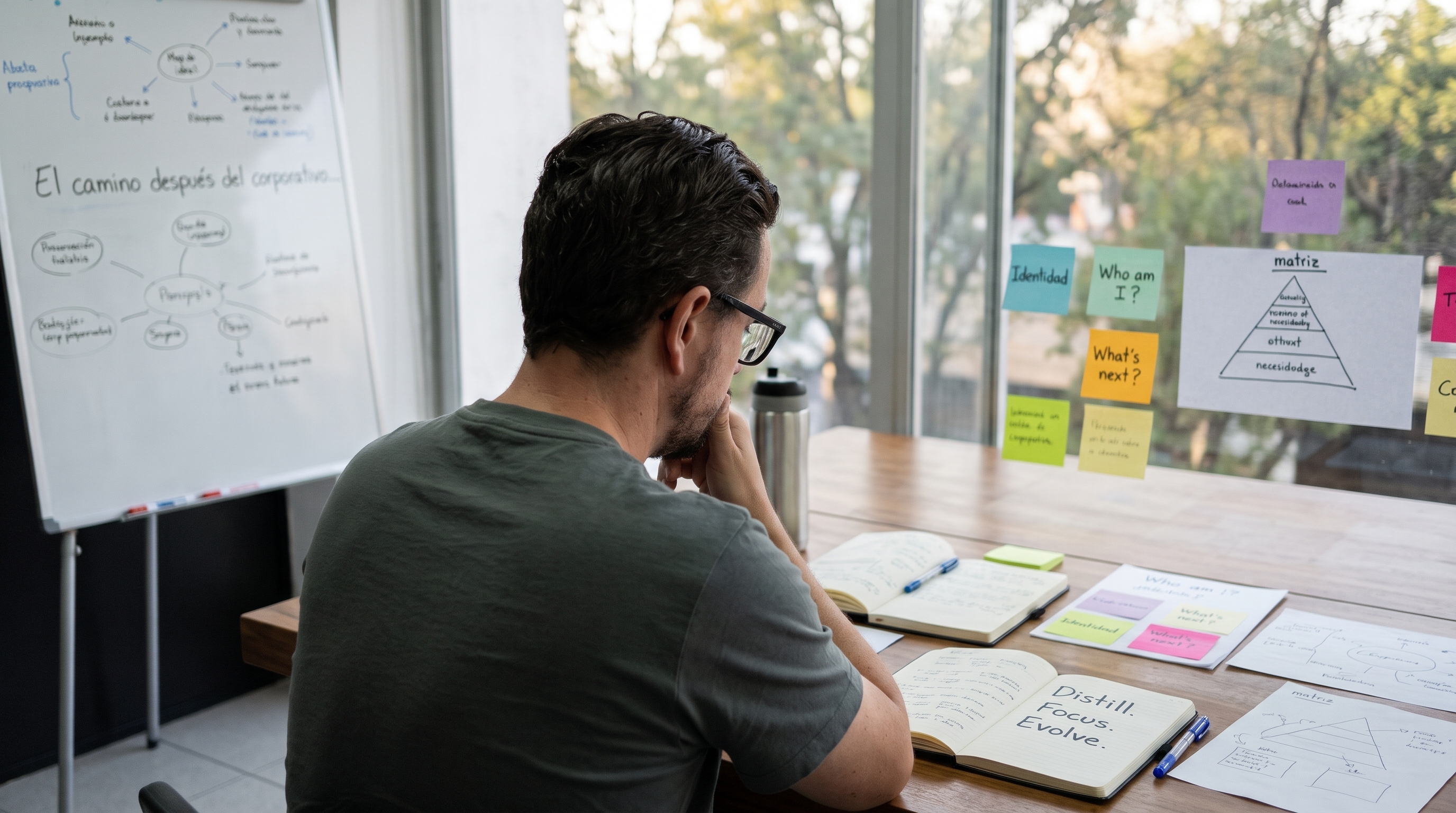
This article grew out of conversations with Emer Kennedy and Natalie McGuinness at Mind Canopy about what comes after leaving corporate life. I'm grateful to both for encouraging me to explore the topic and for their thoughtful feedback along the way.
Leaving corporate is about rediscovering who you are without the identity, structure and certainty that came with the role, not just about figuring out what to do next.
I. The identity you leave behind
Even with room to explore, I still felt uncertain about who I was beyond my job. Maybe you have recently lost your job and have been forced to reconsider your options. Or you might still be in the same role figuring out what to do next, without knowing whether to keep moving up the career ladder, or move into a different industry. Or you may have started to feel uncomfortable and unfulfilled with your job. Despite knowing you're in a privileged position and have a good, stable job… you find yourself in this weird situation.
Let me start with something very loud and clear: this is not unique to you, and you are definitely not alone.
Maslow’s hierarchy of needs offers one way to think about this, and it is often represented as a pyramid, moving from basic needs such as food and security towards belonging, recognition and personal fulfilment. It doesn't mean we all move through life in a fixed order, but it helped me make sense of something I was experiencing. I had a stable job, financial security, recognition and a career I had worked hard to build. Yet I was starting to question why those things no longer gave me the same sense of fulfilment. For me, those questions eventually converged on one word that has been present throughout the last two or three years: identity.
When I talk about professional identity, I don't just mean the job title on your LinkedIn profile. I mean the way your work shapes how you see yourself: what you're responsible for, where you belong, what others expect from you and, perhaps most importantly, what you expect from yourself.
Over more than twelve years at the same company, I changed roles, moved countries twice and built operations in a new market. Somewhere along the way, my professional identity became closely connected to that experience. It felt like wearing the same cap every day.
One day, one month or one year (there’s no specific breaking point), your cap does not represent you anymore. You might not know where it’s coming from, why this is happening to you, or how you’ve got yourself in that “unfair” position of not enjoying a privileged position, feeling quite unfulfilled. You don’t wake up with the same energy, the next step in your career does not motivate you, and you don’t feel as fulfilled as you used to. A new chapter begins.
At first, there wasn't one defining moment. I still had the responsibilities, the meetings and the expectations that came with my role. I often woke up without the same energy for budget meetings or client calls. Things that had once motivated me were becoming harder to feel excited about.
And that left me wondering who I was beyond the role I'd held for so long.
II. The uncomfortable in-between
Without the professional identity I had relied on for years, I began asking myself: Who am I outside my job? What value do I bring, and where? What are my strengths?
My first stop in this journey was grieving and learning to let go. I had spent years seeing myself through my role, and moving away from that took time. Working with my coach over those months also gave me space to question what I wanted and how much of my identity was tied to work. I was starting to accept that my motivations had changed, even if I didn't yet know exactly what I needed instead.
After months of working on myself, I realised something I hadn't fully understood: I had developed two sides of my identity and kept them separate. I was the same person, and I did keep most of the basic values I was raised with: integrity, responsibility, contribution, authenticity, to name a few. How could the kid raised in the countryside and the executive leading over 100 people belong to the same identity?
It turned out I was the same person but I was wearing two different masks. The cap represented my professional identity. The masks were about the way I behaved in different parts of my life. At work, I had learnt to be more serious, measured and conscious of what was expected from me. Outside work, I was more spontaneous, sometimes even a bit crazy, and less worried about how I came across. Neither of those versions was false. They were both me, but I rarely allowed them to meet. A small example of how that has changed is something as simple as a T-shirt. I recently came up with my own mantra, “Distill. Focus. Evolve.” I also printed it on a T-shirt to start wearing it when I’m at work, because it reflects who I am. It might sound irrelevant, but it felt different. I wasn't trying to fit into an image someone expected from me. I was simply comfortable being myself.
III. Learning to explore without knowing the destination
For me, figuring out what to do next happened in parallel with questioning my professional identity. If your professional identity still fits, the next move might simply be finding another job. But when the role itself no longer represents you, the question becomes more complex: what do you want to do next, while you're still figuring out who you want to be professionally?
And that doesn’t need to follow a single path. For me, allowing myself to explore different paths rather than rushing into one decision was useful. Context and circumstances were essential here. This process looks different for everyone. Some people start exploring while still employed; others are forced to rethink their career after losing a job. Financial stability, family responsibilities and the support around us all influence how much room we have to explore.
I began exploring in 2025, while I was still in my corporate role. By the time I left in January 2026, I had some ideas, but no fixed plan. I started with something I genuinely love: wine. Working with a winery gave me the opportunity to explore different parts of a business in an industry I had always been passionate about. As I became more involved in the day-to-day operations, I began to realise that enjoying an industry doesn't necessarily mean enjoying every role within it. I found that the work that gave me the most energy was thinking about strategy, growth and the direction of the business. I enjoyed stepping back, connecting the dots and thinking about where I could add the most value.
That experience helped me understand not only what I enjoyed doing, but also the kind of work I didn't necessarily want to build my next professional chapter around.
That distinction became particularly useful when I started looking at my strengths and experience. It helped me understand which activities I enjoyed, where I could add value, and where those two things overlapped. The map below helped me visualise that. The top-right quadrant, where enjoyment and experience meet, seemed like a natural starting point. But the top-left was interesting too: things I enjoyed but where I might still need to develop new skills.
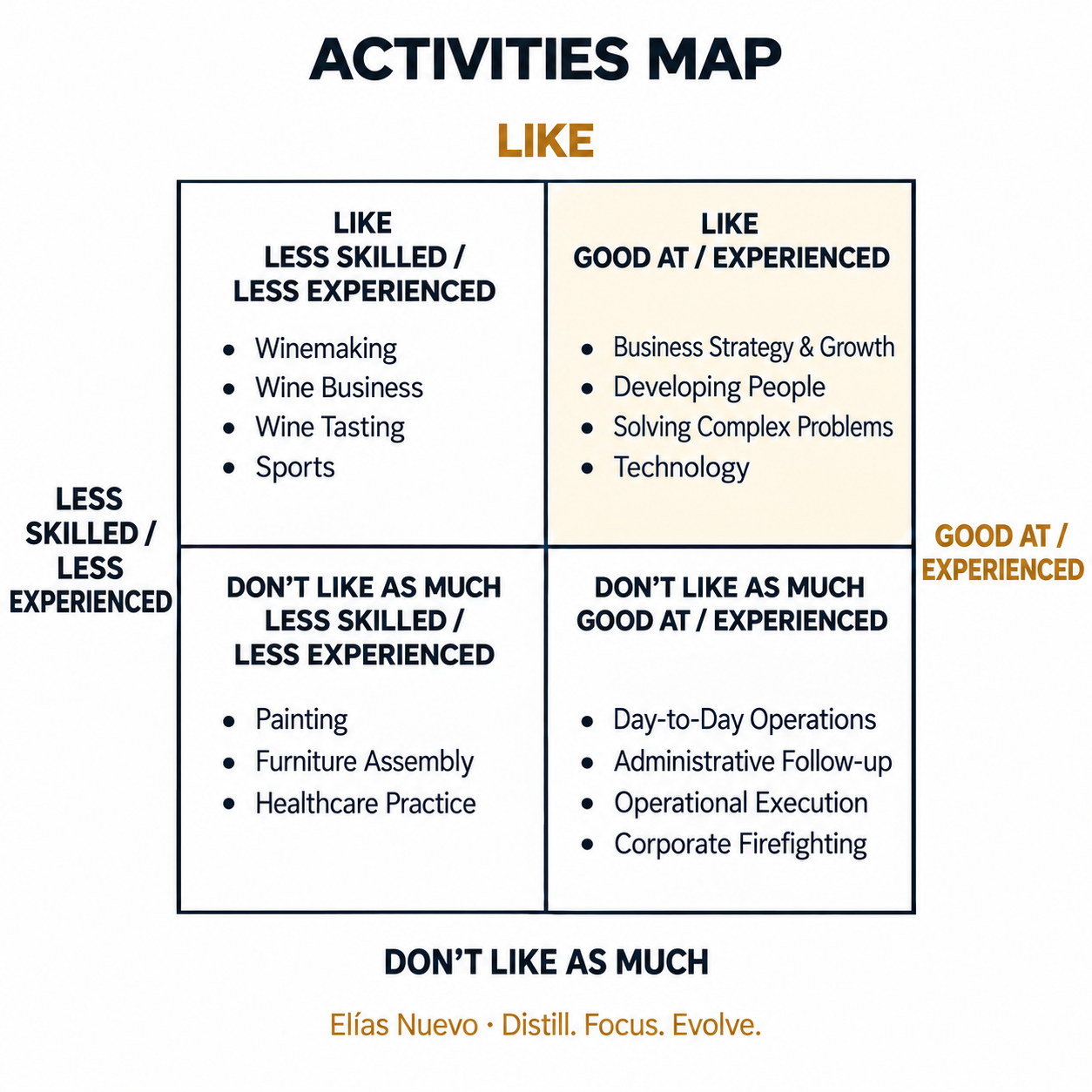
Source: Self
I found myself coming back to three questions: Does this give me energy? Could it be financially sustainable? And would I enjoy the life that comes with it?
In product development, a minimum viable product (MVP) is a way to test an idea before making a big commitment. I approached my own transition in a similar way: trying different ways of working instead of deciding everything on paper. Some experiences confirmed what gave me energy and where I could add value; others helped me understand what I didn't want to prioritise.
I also had to decide how many directions I could realistically explore at once. I didn't need everything to be perfect before starting. Each attempt gave me information to decide what to keep, adjust or leave behind.
Throughout these experiments, I tried to pay attention to two things: how each experience felt to me, and how others responded to what I was offering. The first helped me understand what I wanted to continue doing; the second helped me test whether there was a real need for it. Both informed what I kept, changed or stopped.
Over time, those experiments began to reveal a few directions that made sense for me. I didn't leave my corporate role with a portfolio of advisory, mentoring and coaching already planned. Advisory opportunities emerged organically through my own network; mentoring helps me give back and reconnect with what I enjoy: helping people and their businesses grow; and I also found the right time and environment to explore coaching. I've always enjoyed helping my team and colleagues develop. Some of those conversations already had elements of coaching. Enrolling in Hudson's coaching training programme felt like a natural way to develop those skills and help other professionals and executives. What looks like a clear direction now took months to develop, and is still evolving.
I also realised that exploring possibilities meant learning to say no. Some interesting opportunities came up, including ones I knew I could do well in. But each yes would take time and energy away from something else. I started looking beyond how attractive an opportunity seemed and asking whether it actually fitted the direction I wanted to build, and sometimes the right choice was to let a good opportunity pass. One opportunity was to join a new venture. I believed I could contribute, but it would have taken time away from what I wanted to build. I offered to support it as an advisor instead, and it didn't go any further.
IV. Conclusion
Leaving a familiar path can be unsettling. It takes courage to question things that once made sense, especially when the next step is uncertain. There isn't a single perfect professional path, and it doesn't have to remain constant.
I still don't know exactly where this will take me. My corporate years are still part of who I am, but they no longer have to define the whole of me. The two sides I kept separate are becoming more integrated, and I'm clearer about what gives me energy. I'm still exploring, with more questions than answers in some areas, but with a better sense of who is making those choices.